
At WebexOne in Austin, Texas, October 5–8, 2026, Cisco announced Dialog, a new software layer for its Webex AI Agent platform designed to extend customer service AI beyond individual conversations. Dialog maintains customer context and coordinates work across AI agents, people, and enterprise systems, even after a customer interaction ends.
The announcement represents an important step in Cisco’s CX strategy. After years of building its position in contact center as a service (CCaaS), Cisco is looking beyond the contact center to the enterprise processes that determine whether a customer’s problem actually gets resolved. The distinction is execution: answering a question or identifying an intent is not the same as completing the work that follows.
From Conversations to Relationships
Cisco describes Dialog as an “agentic harness” and a relationship orchestrator. Behind those labels is a practical proposition: customer service work should not stop when the conversation does.
Consider a claim or refund that requires several back-office steps. An AI agent might initiate the process during a conversation, wait for a system update or human decision, and resume when the necessary information becomes available. Maintaining that continuity requires more than a transcript or a summary of the last interaction. It requires a record of the work underway, what remains unresolved, and what should happen next.
Vinod Muthukrishnan, vice president and general manager of Webex Customer Experience, uses the term “long horizon” to describe this approach. Work initiated during or after an interaction can continue for “hours, days, weeks, and months,” he explained. Cisco’s announcement similarly emphasizes persistent customer context and agents that continue working after a conversation ends.
That is the architectural ambition behind Dialog: moving from a succession of disconnected contacts to coordinated work across a customer’s relationship with a business.
Cisco’s Contact Center Journey
For Cisco, that ambition also has competitive significance.
Following Gartner’s publication of its 2026 Magic Quadrant for CCaaS on October 21, a commenter on my LinkedIn post shared the graphic from Gartner’s 2016 contact center Magic Quadrant. The comparison illustrated how dramatically the market has changed over the past decade.
Cisco and Genesys appear in both assessments, although the premises-based contact center and CCaaS reports measure different markets. Genesys accelerated its cloud transition through its acquisition of Interactive Intelligence in 2016. Cisco’s path to establishing its CCaaS position took longer.
Webex Contact Center entered the CCaaS Magic Quadrant as a niche player in 2022. In 2026, Cisco moved from the niche-player quadrant to the challengers quadrant.
Reflecting on that progress, Muthukrishnan commented on LinkedIn: “This is but a milestone before the ultimate destination. The prem MQ picture was a handy motivator.”
I read that as an expression of Cisco’s ambition to re-establish its leadership in contact center and CX technology. Dialog is relevant to that effort because it shifts the discussion from Cisco’s progress in delivering CCaaS to the capabilities it can develop around the platform.
The Architecture Behind the Ambition
The accompanying architecture graphic separates the Webex AI Agent platform into three planes:
- Design plane: AI Agent Studio provides the environment for configuring and training agents, using enterprise policies, procedures, and examples to establish how they should operate.
- Runtime plane: Dialog maintains the active journey. Its journey ledger and event substrate preserve the state of work between interactions, allowing processes to wait and resume rather than start over.
- Control plane: AI Agent 360 provides governance and visibility into agent behavior and performance. New Splunk-based observability connects agent insights with enterprise operational data.
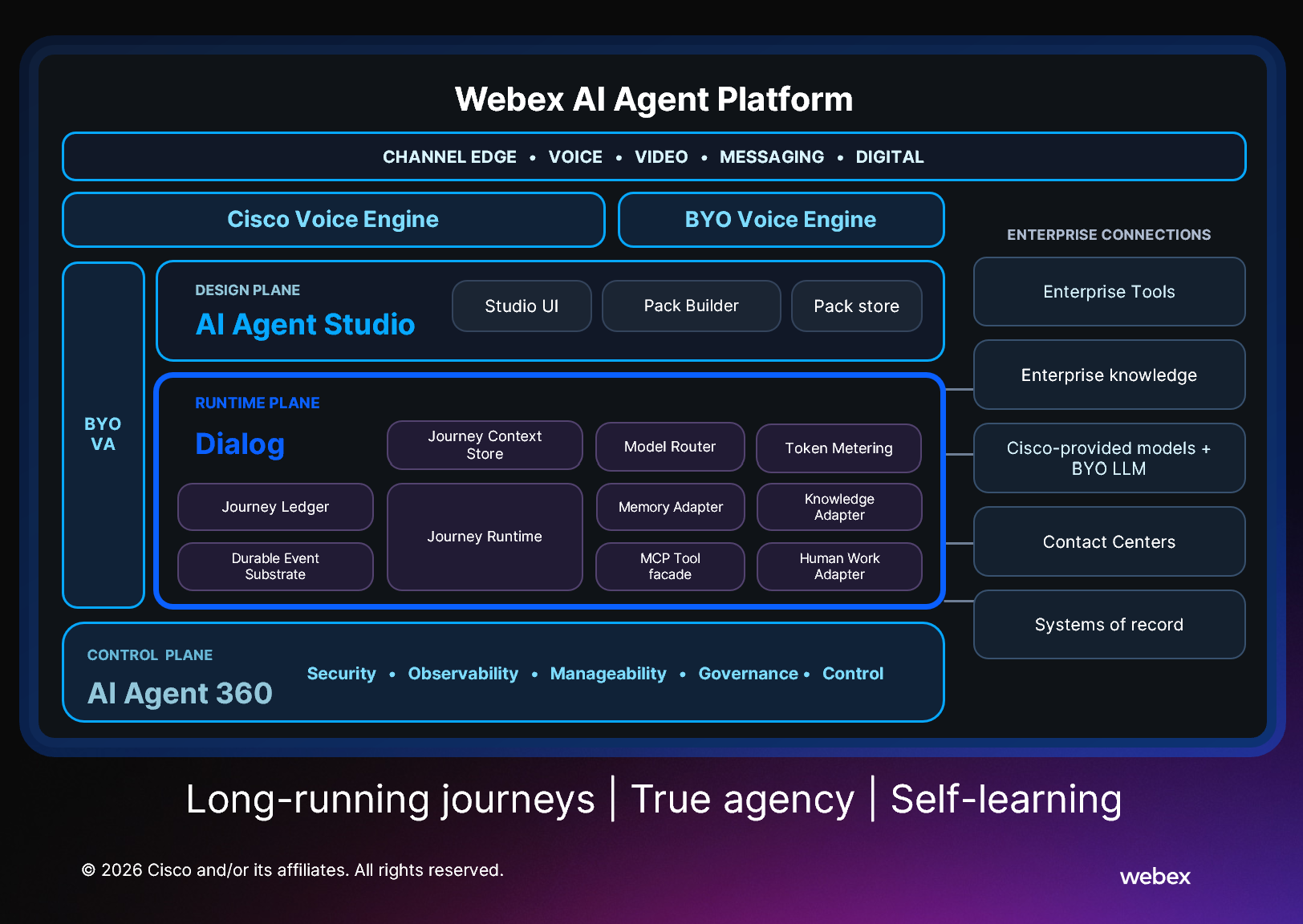
These are complementary functions within the broader platform, rather than three newly announced components of Dialog. Together, they address how agents are configured, how their work continues, and how their behavior is monitored.
The control function becomes particularly important as agents operate for longer periods and across more systems. Cisco’s announcement connects its AI agent capabilities with Cisco AI Defense guardrails and Splunk observability, assets intended to help enterprises manage agents after deployment, not simply create them.
GetixHealth: From Platform Migration to Agentic Workflows
Dialog was developed with a small group of design partners: Webex Contact Center customers looking to extend AI agents into enterprise-wide task completion. According to Muthukrishnan, Cisco’s consulting and forward-deployed engineering teams began with specific, time-consuming processes, validating one use case before moving to the next.
At WebexOne, I met with Dan Womack, CTO of design partner GetixHealth, and listened to Muthukrishnan’s keynote-stage discussion with the company’s CEO, Kevin Lonergan.
GetixHealth’s healthcare revenue cycle management operation provides a demanding environment for this work. Serving more than 600 healthcare systems and 15,000 physicians, with over 1,600 employees operating around the clock, the company needed to stabilize service while supporting a global business.
Its transition from legacy on-premises systems to Webex Contact Center helped reduce dropped-call complaints by 70%. The company also sees an opportunity to bring average call wrap-up time down from seven minutes to less than one.
Those are important platform and operational improvements. They establish the foundation for the next stage of GitexHealth’s relationship with Cisco’s CX team.
GetixHealth is using Cisco AI Agents and Webex AI Assistant for tier-one patient inquiries, including billing, insurance verification, and scheduling. Its broader ambitions include scoring every agent interaction for quality assurance and helping employees develop their skills.
Dialog opens a different set of possibilities. Womack described a scenario in which GetixHealth’s AI agents coordinate with payer-side agents to verify coverage, check claim status, and understand denials. The information could then support resolution of a patient’s billing question.
This is a useful illustration of long-horizon execution. A customer inquiry can initiate work that depends on another organization, a response that arrives later, and additional steps before the issue is resolved. The value would come not simply from one agent talking to another, but from maintaining responsibility for the unfinished process.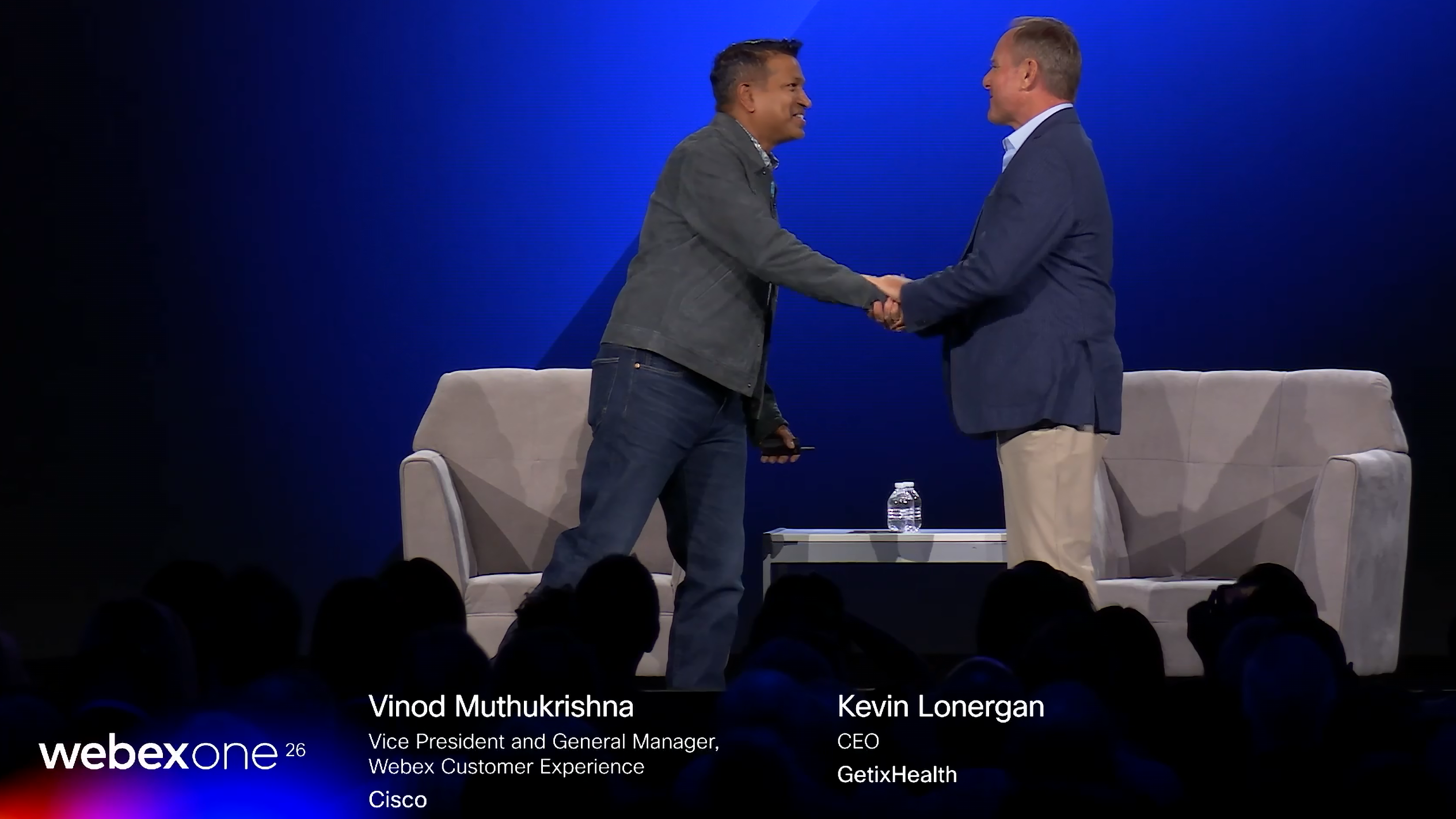
Eligibility re-enrollment is another prospective workflow. Lonergan described anticipated increases in eligibility-verification workload and said the teams are exploring ways to support patients through the process. As with payer-agent coordination, this is an opportunity under exploration.
One Cisco
Dialog also provides a practical lens through which to assess Cisco’s “One Cisco” strategy: bringing capabilities from across Cisco’s portfolio together around an enterprise problem.
For CX, the relevant connections are concrete. Long-running agents need access to enterprise systems, controls on their actions, and visibility into what happens as they work. Cisco can bring security and observability capabilities into that discussion alongside its contact center and AI agent technologies. Dialog’s announcement explicitly links Cisco AI Defense and Splunk to this broader agent architecture.
That combination could become a competitive advantage. Enterprises need more than a convincing agent demonstration; they need a way to operate agents reliably within existing business processes and accountability structures.
Cisco has outlined a credible direction: customer service AI that remains engaged with the work after the conversation ends. GetixHealth offers a useful view of why that matters. The next step for Cisco is to generalize the learnings from GetixHealth and other design partners into a scalable offering that helps enterprises complete more of the work behind customer resolution.
Categories: Intelligent Assistants, Articles
 Opus Research Report: Agentic Commerce, A 15-Year View of a 2-Year-Old Category
 NiCE Delivered on Cognigy. Now Comes the Hard Part.
 The New Economics of Agentic Voice AI: The True Cost Per Resolution
 Five9’s “Humantic” Bet Is Really a Bet on Conversations