
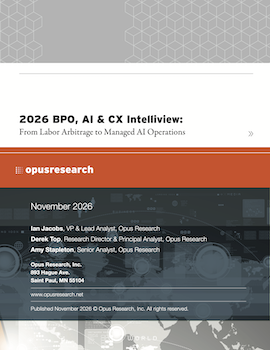
 For decades, the CX BPO business ran on a simple proposition. Providers could recruit, train, and manage people to handle customer interactions more efficiently than their clients could. Labor arbitrage was the engine, and operational discipline kept it running.
Generative and agentic AI put pressure on both parts of that equation. Agent assistance reduces the time and expertise each interaction requires, and autonomous agents take over portions of the work itself. For a provider paid by the hour or the seat, helping a client need fewer people makes for an awkward sales conversation. Yet deploying AI also creates substantial new work: connecting systems, maintaining knowledge, defining authority, testing behavior, managing escalations, and proving the results justify the cost. The open question is whether BPOs can turn that work into a business clients will pay for.
Opus Research’s 2026 BPO, AI & CX Intelliview report helps answer that question. It evaluates six CX BPOs (Concentrix, Firstsource, Foundever, iQor, TELUS Digital, and TP) and examines how the provider applies AI inside its own delivery operations and in the services it brings to clients. The report draws on RFI responses, analyst briefings, and product demonstrations. It also includes a reference profile of Crescendo, an AI-native CX platform that serves as a benchmark for autonomous customer service.
Key topics of the report:
- The BPO AI Maturity Model: A two-axis framework that places each provider’s internal operations and customer-facing offerings on a path from labor-based delivery to AI-native operations.
- Six dimensions of the AI operating model: Frontline augmentation, autonomous customer service, workforce transformation, analytics and optimization, client-facing AI services, and governance and control, each scored for every provider.
- The 2026 Intelliview Map: Leading providers each with distinctive strengths buyers should weigh against specific needs.
- BPOs sell AI better than they run it autonomously: Client-facing AI services is the cohort’s strongest dimension, and autonomous customer service its weakest.
- Proof is the market’s weak point: Reported containment figures vary widely, and definitions differ from provider to provider. Buyers should insist on baselines, attribution, and evidence that results repeat across accounts.
- Accountability by design: When the client, the BPO, and the technology vendor each control part of the AI system, ownership of errors, handoffs, and remediation must be assigned before launch, not after the first failure.
- Company dossiers: Profiles of each provider’s AI capabilities and service delivery, safety and governance, people and workforce models, and track record.
No provider has yet achieved AI-native delivery. The BPOs that win the next phase will be those that prove their combined human-and-AI operations deliver results software vendors and systems integrators can’t match.
Featured Research Reports are available for clients and registered users only.
Click Here to View the Report Summary
For more information on becoming an Opus Research client or to purchase the report, please contact Peter Headrick (pheadrick@opusresearch.net, +1-415-505-2511).
Registered Opus Research Advisory Clients – Click Here to View the Full Report
Categories: Conversational Intelligence, Featured Research, Intelligent Assistants, Intelligent Authentication, Articles
 Opus Research Report: Agentic Commerce, A 15-Year View of a 2-Year-Old Category
 Opus Research Report: Why Customer Experience Needs an AI Agent Control Plane
 Opus Research Report: How AI Is Reshaping CCaaS Spend
 The BPO Wake-Up Call: AI Is Rewriting the Rulebook