
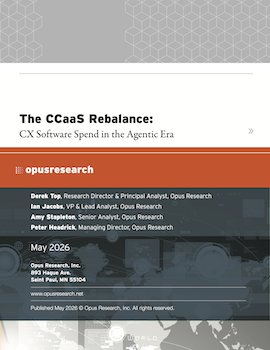
 For much of the past year, Opus Research has been writing about something we call the CXO control plane — the layer above the contact center where enterprises will increasingly govern AI behavior, route work between human and machine agents, and prove that any of it actually creates value. It’s been a useful frame for thinking about where customer experience is headed. But until recently, it’s been mostly architectural, mostly conceptual.
This new Opus Research report puts numbers on it. Over the next two to three years, Opus projects core CCaaS platform spend (routing, channels, the interaction layer everyone pays for) will compress from about 33% of the mix to 21%. That’s a 12-point shift — real money, moving meaningfully. And it’s moving somewhere specific: up the stack, toward orchestration, agent assist, analytics, and the AI-native automation layers that increasingly shape what customers actually experience.
The Pricing Problem Nobody Has Solved
There’s a complication threaded through all of this. AI has broken the per-seat pricing model that CCaaS was built on. Inference costs, retrieval pipelines, voice synthesis, and agentic reasoning carry variable, often opaque unit economics. Vendors are testing consumption-based, outcome-based, and hybrid pricing, but few enterprises have the telemetry or finance practices to evaluate them confidently.
In the 1983 movie “Superman III,” Richard Pryor’s character becomes a millionaire through a “salami slicing” scheme that quietly shaves fractions of a cent from millions of transactions into his own account. This is a useful metaphor for how tokenization and AI-driven micro-consumption are reshaping CCaaS and CX spend, as enterprises now pay for tiny, almost invisible metered units (tokens, orchestrated interactions, model calls, and evaluated flows) that aggregate into significant budget and strategic leverage at scale.
This pricing ambiguity is the single biggest friction point slowing AI deployment in CX today. The fix is not to wait for vendors to converge on a model. It’s to start measuring proof of value per interaction rather than per seat, and to demand transparency on AI consumption layers, even when bundled. (Note: Opus Research will be exploring the AI CX pricing conundrum in another upcoming report.)
The Bigger Pattern
Every wave of CX technology has followed roughly the same arc: a new capability arrives as an overlay, gets adopted as a standard, and eventually subsumes the layer beneath it. Cloud did this to on-premise. Omnichannel did this to single channel. Conversational AI is doing it now to scripted interaction.
What’s different this time is the speed of the migration and the size of the layer being absorbed. Orchestration is not just another overlay. It is the place where AI behavior gets governed, measured, and optimized, which makes it the place where competitive advantage in CX will be built or lost over the next decade.
The full report walks through all ten categories, the directional model behind the projections, and what the shift implies for buyers and vendors. If you’re a CCaaS buyer, the question isn’t whether to budget for the control plane. It’s whether you’ll own that layer or rent it from someone else. The base platform still matters. The center of gravity has moved.
Featured Research Reports are available for clients and registered users only.
Click Here to View the Report Summary
For more information on becoming an Opus Research client or to purchase the report, please contact Peter Headrick (pheadrick@opusresearch.net, +1-415-505-2511).
Categories: Featured Research, Conversational Intelligence, Intelligent Assistants, Intelligent Authentication, Articles, Mobile + Location
 Opus Research Report: “Executive Survey: Drivers for Deploying Speech Analytics (2017 Edition)”