
The November midterm elections dramatically shook up Washington. Democrats will control both houses of Congress starting in January, and there’s already lots of talk of increased regulation of artificial intelligence. For the customer experience industry, that raises questions about how aggressively brands will be able to deploy AI agents. But there’s another industry that could be affected in a rather unexpected way. Contact center business process outsourcers (BPOs) might actually benefit from greater AI regulation. At least for a while.
Before getting too carried away with this scenario, let’s consider the odds.
I’ll put the likelihood of significant new federal regulations that materially constrain customer service automation over the next two years at about 25%. That’s my admittedly wildly unscientific estimate.
Why so low? Although Democrats will control Congress, the President retains veto power (he even joked about becoming known as Mr. Veto). Also, due to the filibuster, the Senate’s 60-vote threshold remains a substantial obstacle. I’m sure there’s room for bipartisan agreement on certain AI protections, but sweeping restrictions seem considerably harder to achieve. Still, 25% isn’t zero. And the prospect of regulation, even without legislation actually passing, could make brands more cautious about deploying autonomous AI agents. That’s where things get interesting for CX BPOs.
Labor Arbitrage Rides Again
For years, the BPO industry’s traditional economic advantage has rested largely on delivering customer service using lower-cost labor. AI, famously, threatens that advantage by promising to eliminate much of the human effort involved. Labor arbitrage doesn’t look so hot when there is no labor! As we explored in our recently published BPO Intelliview, providers are already grappling with the shift from labor arbitrage to managed AI operations.
But now consider what happens if new regulations complicate that equation. Requirements for human oversight, direct access to human agents, more extensive testing, auditability, or restrictions or even bans on certain automated interactions could increase the cost of deploying AI. Even where automation remains legal, compliance requirements could lengthen implementation timelines and reduce the savings brands expect.
That obviously changes the economics of AI in service delivery. A brand planning to automate 40% of its contact center interactions might suddenly find that only 20% can be automated economically within its original timeframe. The remaining interactions still need to be handled via the traditional human route. And if the brand has already committed to reducing service delivery costs, maintaining an expensive onshore workforce isn’t particularly appealing.
Enter the CX BPO.
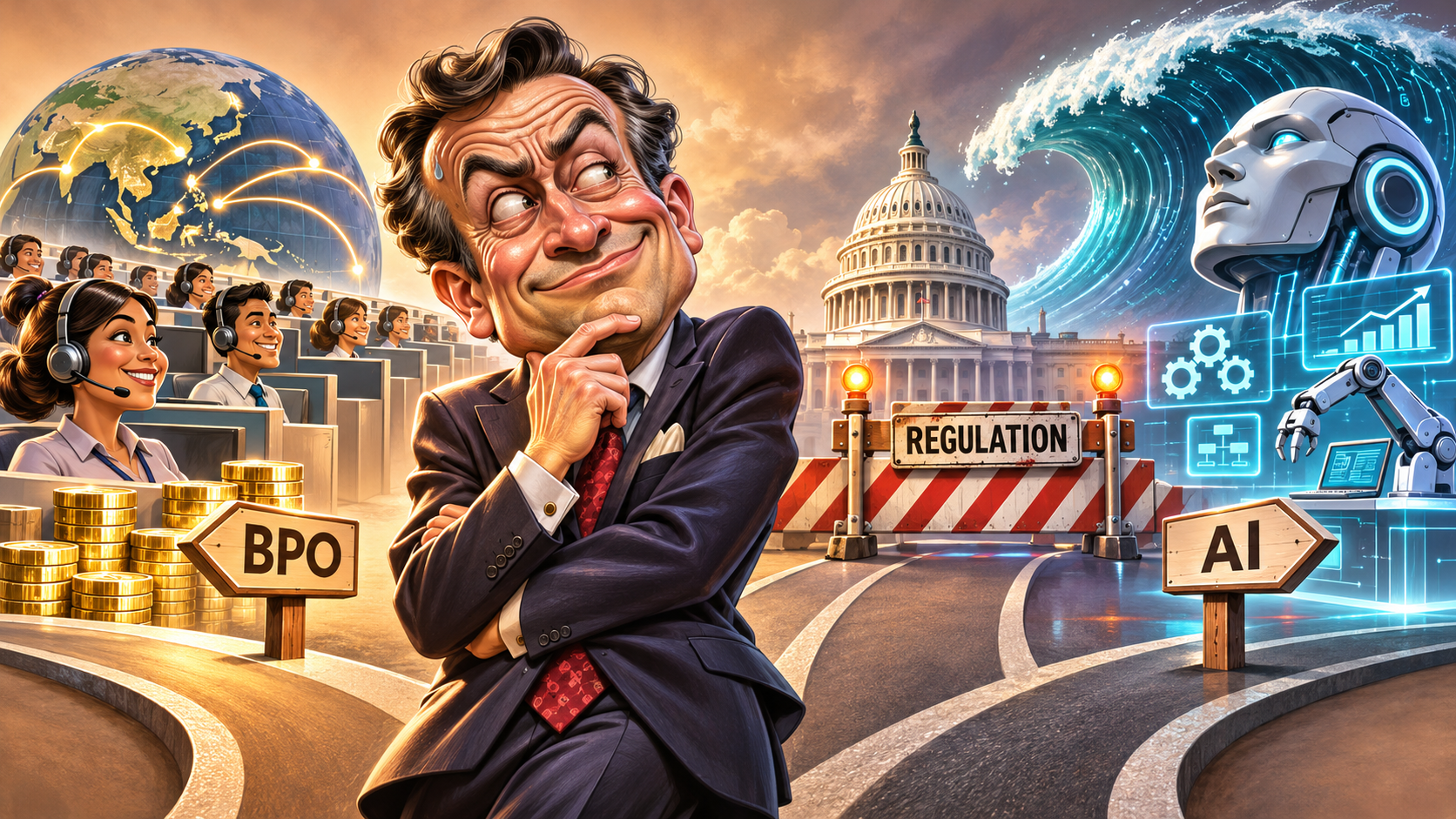
Outsourcing those interactions to a lower-cost delivery location could become the fastest, least disruptive way to capture savings that AI automation can no longer deliver on schedule. Existing BPO relationships might also become stickier. Brands could extend contracts rather than risk service disruption while they figure out how to comply with new AI requirements. Providers might even pick up additional volumes originally earmarked for automation.
Of course, regulation wouldn’t automatically increase demand for human agents. Brands would still automate whatever they could, and the same regulatory constraints would apply to BPO-delivered AI. But slowing the replacement of human labor could preserve outsourcing revenue that otherwise would have disappeared. Even with all those caveats, regulation could temporarily make the traditional BPO value proposition more competitive against autonomous AI.
A Dangerous Temptation
But that potential gift could also become a trap. Just imagine you’re running a BPO (many people’s dream career, I’m sure). Traditional outsourcing contracts are holding up better than expected. Clients are extending agreements and buying more human-delivered services. Your established business is generating healthy revenue. Meanwhile, those expensive AI transformation initiatives are taking longer to pay off than anticipated. Why not redirect some investment toward the business that’s actually making money day-to-day?
It’s not hard to imagine the temptation. And it probably wouldn’t involve any explicit decisions to abandon AI. More likely, we’d see AI development budgets trimmed, autonomous service initiatives delayed, and sales teams refocusing on traditional outsourcing deals.
Each decision could make sense in isolation. As we’ve argued in our research on proving the value of BPO AI, those investments need to be measured against operational outcomes, not just immediate cost savings. But collectively, they could leave BPOs dangerously unprepared because the economic forces driving AI adoption aren’t going away. AI capabilities will continue improving. Enterprises will get better at governing autonomous systems. Regulatory frameworks will eventually become clearer, even if they are more restrictive than the current “don’t fence me in” approach to legislation. When that happens, brands would likely snap back towards automation. BPOs that used the reprieve to rebuild their traditional labor-intensive businesses might discover they’ve been investing in yesterday’s operating model.
Preparing for the Pendulum to Swing Back
Yes, all of this is supposition and an intellectual exercise. However, greater regulation could actually create opportunities for BPOs that have invested heavily in AI. These providers already have experience managing complex customer service operations under contractual and regulatory constraints. Extending those capabilities into AI governance, evaluation, human oversight, and orchestration could become a valuable service offering. In the interim, AI-powered agent assistance, quality management, and operational optimization can improve the economics of human-delivered service even when autonomous AI faces restrictions.
So, if the regulatory pendulum swings, BPOs should certainly take advantage of any near-term commercial opportunities. But they should also use the additional revenue and breathing room to accelerate their transformation.
A 25% possibility of meaningful AI restrictions is worth preparing for but it’s probably a lousy foundation for a long-term business strategy. Even unlikely scenarios are worth exploring because they force BPOs to examine the assumptions behind their strategies. The goal isn’t really to predict what Washington will do. It’s to make sure that whatever happens, short-term opportunities don’t derail long-term transformation.
Categories: Intelligent Assistants, Articles
 Sprinklr Bets That Context, Not Agents, Wins the Next Round of CX
 2026 BPO, AI & CX Intelliview: From Labor Arbitrage to Managed AI Operations
 Dialpad and Ada Combine to Build a Platform for Customer Work
 The Missing Grammar for Multi-Agent Customer Journeys