
 If you spend enough time following the AI industry, you could get the impression that every business is already running on AI agents. The models keep getting smarter, the demonstrations are impressive, and everyone is talking about what comes next.
Then you call a company and find yourself working through the same phone menus you’ve been navigating for years.
I think of this as the “reality gap.” There’s a considerable distance between what AI can now do and what businesses have actually put into practice. Plenty of contact centers still rely on conventional IVRs and on chatbots built around older natural language understanding technology. Others have started experimenting with generative AI, but are still working out how to move beyond a pilot.
NiCE’s announcement last week of the next generation of NiCE Cognigy addresses that gap. The company is using AI itself to help businesses figure out where to start and to accelerate the creation of an initial agent. The new platform also helps the team work through the steps needed to put the AI agent into production.
Figuring out what to build
For a business that hasn’t deployed AI agents, the first question is often where they would actually help. Which customer requests are good candidates? Which processes create unnecessary work? Where could an agent complete a task that currently requires a customer to wait for a person?
At NiCE’s recent analyst summit, we saw how the company uses LLMs to examine customer interactions and then identify opportunities to improve processes and automate tasks. I mentioned this in my earlier post about the summit. Those conversations contain a lot of evidence about what customers need and where existing service falls short.
The next-generation NiCE Cognigy briefing focused primarily on the new tools for building, testing and improving agents. NiCE also discussed integration with Agentic Analytics and generating agents from available data.
I see connecting those capabilities more directly as an important opportunity. A business can start with problems its customers are already bringing to the contact center and use those interactions to inform what the agent should do. For CXone customers, this fits into NiCE’s broader approach to learning from interactions and feeding those insights back into service improvements.
An AI companion for building agents
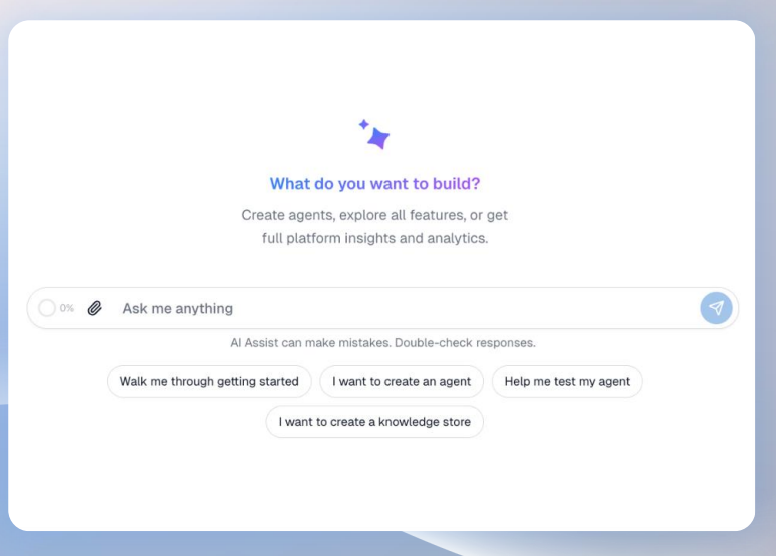 The next-generation NiCE Cognigy gives teams more help turning an opportunity into a working agent. Its AI Assist feature is something like a superpowered wizard that knows the platform and guides the team through the work. Teams can create agents from prompts or conversation transcripts, then add the knowledge, skills and tools those agents need.
Having a working starting point changes the conversation. People can try it, see what it does, and decide what needs to improve. I think this creates room for business people with some technical chops to participate more directly in building agents. They know why customers call, how requests get resolved and which policies cause confusion. Giving them tools to turn that knowledge into agent behavior could help companies make progress with the people they already have.
Technical colleagues will still have important work to do, especially around integrations. But more of the initial creation and refinement becomes accessible to the people closest to the service being delivered.
Getting from a first version to production
Of course, generating an agent is only the beginning. Customers leave out information, change their minds and ask for things in unexpected ways. An agent that handles a straightforward demonstration might struggle when those complications appear.
NiCE Cognigy includes simulation tools for testing agents against synthetic customers. Teams can compare versions and make changes before exposing customers to the experience. Tracing provides visibility into the skills activated, tool calls, and information used, helping teams investigate what happened when an interaction went wrong and providing data for the enterprise’s decision ledger.
The platform also supports combining agentic behavior with defined (deterministic) workflows. A business might give an agent flexibility in understanding a request while requiring a prescribed process for checking eligibility or authorizing a transaction. Existing deployments can continue running as customers introduce the new capabilities.
That continuity matters for companies with years invested in their current systems. They need a manageable path to introducing AI, with time to test, learn and expand.
NiCE also demonstrated speech-to-speech support, currently in preview, designed to make voice conversations more natural while the agent delegates tasks to tools and workflows behind the scenes.
Making the next step easier
Taken together, these capabilities support the full lifecycle of an agent, from creation and testing through deployment, analysis and ongoing improvement. AI Assist is intended to help throughout that process.
There’s still real work involved. Companies need usable knowledge and connections to business systems. They also need clear policies and people accountable for the results. Easier agent creation won’t resolve all of those requirements.
But these tools can remove some of the friction that keeps businesses from getting started. A team that can quickly build an initial agent, test it and understand where it needs improvement has a more manageable path toward deployment.
The broader opportunity is to connect that development process with what a company learns from its customer interactions. That could help businesses answer both questions that so often slow adoption. Where should we start? And how do we get something useful into production?
NiCE Cognigy is applying AI to the practical work of getting AI into service. For enterprises still looking across the reality gap, that offers a more achievable next step.
Categories: Articles
 What Happens to BPOs if Washington Puts the Brakes on AI?
 Sprinklr Bets That Context, Not Agents, Wins the Next Round of CX
 2026 BPO, AI & CX Intelliview: From Labor Arbitrage to Managed AI Operations
 How AI Agents Are Changing Shopping and What Comes Next