
We at Opus Research are pleased to welcome Sheila McGee-Smith as a contributor and collaborating analyst. In her first article for the Opus site, Sheila looks at what Salesforce’s acquisition of Fin means for Agentforce Contact Center and CX buyers and decision-makers.
Days before the start of Dreamforce, Salesforce announced the completion of its acquisition of Fin.AI. An update on where Fin’s solutions and customers fit within the company organizationally and strategically was of interest. Six months after the announcement of Agentforce Contact Center (AFCC), also top on my list of things to discuss with Service Cloud leaders was how the new CCaaS solution is being received by Salesforce customers and how the delivery of announced 2026 roadmap capabilities is proceeding.
Fin for Speed and New Logos
Salesforce’s acquisition of Fin, formerly Intercom, brings Fin’s customer agent platform, its AI team, and more than 30,000 customer companies worldwide to Salesforce. Marc Benioff has commented that the acquisition was “the number 1 customer agent meets the number 1 CRM.”
During the dedicated industry analyst summit within Dreamforce, John Somorjai, Salesforce’s Chief Corporate Development and Investments Officer, said, “What we heard resoundingly from our customers was they wanted a service agent that was easy to implement and get running quickly, so they could show time to value.” He went on to say that “the average implementation time for a Fin AI Agent is 18 days,” and that most companies do it using self-service, without using forward-deployed engineers (FDEs).
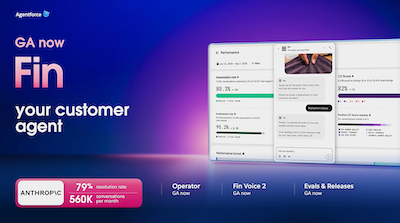 Kishan Chetan, EVP and GM, Agentforce and Service Cloud, explained during a one-on-one briefing that Fin will work closely with Salesforce AI Labs. Chetan explained that it is where Salesforce incubates acquisitions that bring their own model capabilities, presumably with an eye toward making sure that new intellectual property becomes an asset across all Salesforce business units.
Chetan went on to say that the running of the Fin business and responsibility sit within Service Cloud. Fin’s AI agents run on the Fin Apex model suite, a system of specialized, proprietary models built on an open-weights foundation and trained specifically for customer experience, handling discrete stages of a support conversation from intent detection through resolution. Chetan said that moving standard conversations to Apex models allows Fin to bypass commercial foundation APIs for the vast majority of tasks, which makes Fin much less expensive to run.
Somewhat surprising to me was Fin being positioned during Benioff’s keynote as one of seven out-of-the-box agents, including: Piper, an inbound pipeline generation agent; Hunter, an outbound sales agent still in pilot with general availability expected in November 2026; Casey, a help agent; Paige, an IT and HR employee agent; Carter, an online retailer consumers’ product FAQ agent; Marshall, a supply-chain and back-office agent; and Fin, described as a customer agent. It resolves complex queries end-to-end across live chat, email, WhatsApp, SMS, voice, and Slack.
Salesforce is positioning Fin alongside Agentforce, not as a replacement for it. Salesforce frames Fin as giving customers more choice, from quick deployment on existing systems to deeply tailored enterprise-scale projects. In practice, that means Fin for simpler use cases that need to be running quickly, and Agentforce for complex, customized ones.
Chetan tied Fin to Salesforce’s corporate growth goals in two ways: winning customers and reaching companies whose service platform is not Salesforce. Fin works with the helpdesks companies already use, including Salesforce rivals such as Zendesk and the Intercom helpdesk solution, which Salesforce will continue to sell. This increases Salesforce’s total addressable market, as the company can look for new AI customer logos in companies where it is not the service platform today. Fin’s self-service, no-salesperson-required sales motion also gives Salesforce a way into the very small business segment (under 10 employees) and an additional source of new logos.
That said, Chetan commented that the Fin agent itself is not an SMB-only product and is strong in large high-tech companies, including Anthropic. That is a useful tension to sit with: Salesforce is selling Fin at once as a fast, self-service on-ramp for businesses and as a serious platform for sophisticated AI-native buyers, a dual positioning that says as much about where Salesforce expects Fin’s growth to come from as any org chart does. Salesforce says Fin will keep serving its existing customers and building its own models. Because the deal closed only days before Dreamforce, Chetan said a closer look at how Fin’s orchestration layer and its extensions into sales and vertical use cases will fit into the Salesforce platform is still ahead.
Agentforce Contact Center, Beyond Voice
Salesforce customers have used its digital channels for years, often alongside another vendor’s telephony. What changed in March 2026 was the platform supporting these digital channels. When AFCC launched, Salesforce put voice and all digital channels not only into one product but onto one platform. In a one-on-one briefing after Dreamforce, Gautam Vasudev, SVP, Agentforce Contact Center, Salesforce, explained why the company counts AFCC customers from that date. “March was the moment when we brought all of our channels together under one contact center offering, and all our AI.” Before that, he said, native voice had not launched yet, the available digital channels served Service Cloud customers, and Marketing Cloud channels ran on a separate stack.
Now, Vasudev says, “Customers buy our contact center product, and you get all channels.” Chetan, who leads Agentforce and Service Cloud, was candid that the digital capability itself is “not news.” The real change was moving the digital channels’ runtime environment off Salesforce’s older channels platform, onto “the same platform that now supports voice and digital channels.” That work started before AFCC, and Chetan credits it as the platform that allowed the AFCC voice channel capability to be added so quickly.
The biggest gain from the new platform is unified routing. Before, Chetan said, “you had to split out the digital channel routing versus the voice routing.” That matters because many customers still run another vendor’s contact center solution for telephony and Salesforce for digital. Salesforce saw the need, as he put it, “to route across all of those channels.”
The new voice and digital channel platform is also available beyond Service Cloud. Vasudev remarked, “Salesforce has an internal Twilio,” used by Service Cloud, Sales Cloud, and Marketing Cloud. I interpreted that to compare how the new AFCC platform was constructed to how Twilio built Flex, as a set of separate APIs for building a contact center. Vasudev agreed and said his team can now deliver channels as services to other parts of Salesforce. “In this case, our customers just happen to be Salesforce clouds versus end customers,” Vasudev summarized.
The use of a single platform for voice means that “any conversation in the enterprise goes into the same conversation store, and your AI agents, whether it’s sales, service, or marketing, are operating with the same context,” said Vasudev. Chetan explained how Salesforce sells the shared platform: it is “packaged as Agentforce Contact Center for a Service use case” and as messages for marketing, “but the platform is the same.”
Since the March 2026 launch, channels have continued to be added. One is Rich Communications Services (RCS), an upgrade to SMS that supports richer, interactive messaging. Vasudev described it as enabling two-way marketing conversations: a customer receives a message inviting a reply, and an AI agent can handle that response directly within the same thread, rather than routing the customer elsewhere to continue the conversation.
Salesforce is seeing momentum across all the distinct options for deploying AFCC, citing 1,200 new customers since March 2026 including native telephony, digital engagement, and partner contact center customers.
Examples of digital-only AFCC customers range from a small dog grooming operation to a Brazilian government agency that uses WhatsApp to message the country’s entire population. Vasudev said most of Salesforce’s Contact Center customers with over 2,500 seats are digital, billed on a consumption basis.
For most existing customers, the move to the new platform has been invisible. Chetan said almost 80 percent of the several thousand legacy digital customers have already moved and predicted “virtually everybody” will be off the older platform by the end of next year. Vasudev added that for channels like WhatsApp, SMS, and LINE, where Salesforce is not the user interface, the migration has been “completely silent.” The exception is customers on the legacy chat product. They must do an actual migration to get the new, more immersive “ChatGPT style chat experience,” according to Vasudev.
Salesforce as a CX Company
Zooming out, Dreamforce 2026 marked a shift in how Salesforce wants to be perceived. Thinking back to Dreamforce 2024 and 2025, I saw Salesforce trying to position itself as an AI company. In 2026, because every company has embedded AI into its solutions, I the company emphasizing a shift from CRM company to customer experience platform.
There has always been co-opetition between CRM and CCaaS vendors. The stakes are higher than ever, with orchestration and execution of AI as the new area for growth both types of companies want to win. To make their AI agents effective, CCaaS vendors are forced to build deep CRM connectors or create their own mini customer-data-platforms (CDPs) or customer profile repositories. Similarly, Salesforce saw the value in building its own telephony platform. Regrettably, that only makes the buying decision more difficult for the end user.
Categories: Conversational Intelligence, Intelligent Assistants, Intelligent Authentication, Articles
 Salesforce’s Agentic Enterprise: A Coherent Architecture, an Unfinished Operating Model
  Building the Analytics Flywheel for Conversational and Agentic AI
  AI Platform Selection for CX Is Now an Architecture Decision
  Agent Sprawl Is a Success Problem That Needs an Operating Model