
 Salesforce used Dreamforce 2026 to tell its most coherent architecture story for the agentic enterprise. Agentforce is maturing quickly, Salesforce’s named AI agents are multiplying (including Piper, Hunter, Casey, Paige, Marshall, Carter, and, next, Fin), and the company’s partnership with Anthropic adds another dimension to its strategy for putting AI into the flow of work.
From the main stage and in analyst conference sessions, Salesforce laid out a clean, four-layer model for the “agentic enterprise.” But there remain gaps on who will coordinate, govern, evaluate, and account for the work of many agents operating across many platforms. Salesforce has built a strong harness for making agents in its own ecosystem more capable and trustworthy. It has not built, and does not appear to expect to own outright, the enterprise control plane needed to manage a multi-vendor agentic workforce. That distinction will shape the next phase of competition in CX.
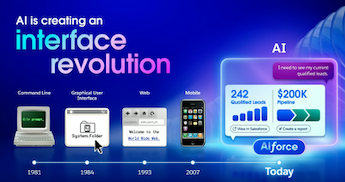
Salesforce’s model is straightforward. Data 360 provides trusted context. Customer 360 supplies the applications and workflows. Agentforce is the runtime environment where agents execute work. AIforce is the interface layer, extending agents into the places where work happens, including Slack and Claude.
Around that architecture, Salesforce introduced Koa, a CRM reasoning model built on NVIDIA Nemotron for longer-running agents. They also have Salesforce Guardian for security and MuleSoft Agent Fabric for connecting MCP servers, LLMs, agents, and enterprise systems.
The strategic argument around context is compelling. Agents are only as useful as the data, business rules, policies, permissions, and workflows that ground their actions. If Salesforce is the system of record, it already holds much of the information an agent needs to understand a customer and take action. Context, though, is not the same as control.
We look at three questions from Dreamforce 2026: who coordinates agents across vendors, whether Salesforce can become a serious contact center platform, and what happens to the people working alongside agents.
A Harness Is Not a Control Plane
Salesforce frames governance through its Trusted Enterprise AI Harness, organized around models, context, agency, actions, governance, and security. It is a useful framework because it asks whether an agent can be trusted to operate responsibly.
But a harness and a control plane are not the same thing. A harness makes an agent reliable. A control plane makes many agents work as one system. At Opus Research, we define the control plane as the shared operating layer that coordinates people, agents, workflows, systems, data, policies, and outcomes. It becomes essential when work crosses vendor boundaries.
That is where the challenge begins. A customer journey may move from a voice bot to a human representative, from a CCaaS platform to Salesforce, from Slack to an internal application, and from one AI agent to another. Enterprises need to know what happened across that entire journey, including which agent acted, what authority it had, what data it accessed, which policy applied, whether consent was honored, and whether the outcome was accurate.
Salesforce is strongest where work stays within Salesforce. The coverage becomes less complete when journey state, identity, governance, or audit history must travel beyond the native stack. Agent evaluation also remains an emerging requirement across the industry.
Compass Working Capital offers a practical example. The nonprofit uses Agentforce to reduce post-call documentation from roughly 25 minutes to five. AI drafts client records from call transcripts, while coaches review and approve the final content. Caseloads have grown from about 75 to more than 150 clients per coach, without removing the human from the relationship.
Yet Compass is also exploring Claude for dashboards and Slack workflows. Even a small, deliberate adopter could rapidly become a multi-vendor AI environment. Nowhere is that multi-vendor reality more entrenched than in the contact center. Salesforce’s answer is to remove the boundary altogether.
AIforce Could Make CCaaS More Interesting
 Salesforce’s CCaaS pitch has to be judged on more than the usual all-in-one story. Yes, there’s obvious appeal in combining CCaaS, CRM, and telephony in one environment. As one executive put it at Dreamforce, the goal is “no more tool stitching ever again.”
For brands already heavily invested in Salesforce, that could be compelling. Contact center architectures still require a lot of integration work just to keep customer context, interactions, dispositions, workflows, and AI synchronized across systems. Salesforce is betting that the best integration is no integration. If telephony and CCaaS become native to Customer 360, that could simplify deployment considerably.
That argument should resonate most quickly in the midmarket and below, where simplicity often carries more weight than feature depth. For large enterprises, the picture is murkier. WFM is coming, but many of the capabilities buyers expect from mature CCaaS platforms remain hazy. But, honestly, Salesforce doesn’t need to out-NiCE NiCE on day one. It needs to make the integrated option easy enough for Salesforce customers to stop shopping.
AIforce adds another wrinkle. Salesforce spent a lot of Dreamforce talking about dynamic, composable interfaces that reshape themselves around user intent. That idea is a poor fit for contact centers. Large operations depend on consistency. They measure clicks, adherence, workflow efficiency, QA scores, and agent behavior with extraordinary precision. An ever-changing desktop makes that much harder. Composable could be great for a VP of CX but the front-line folks run on repeatability.
But that doesn’t mean AIforce has no value in CCaaS. An interesting opportunity is what happens behind the interface. AIforce could understand the interaction, customer history, permissions, workflows, and business rules, then retrieve context, trigger actions, update records, summarize conversations, or coordinate other agents without forcing the human agent through five different Salesforce modules.
That same idea could extend into WFM and supervisor tools. A supervisor might ask why service levels dropped, have AI correlate staffing, volume, absenteeism, and handle time, then propose and execute an approved schedule change. The value in that scenario isn’t a prettier WFM screen. It’s changing the screen from a place where people manually do the work into a place where they direct and govern it.
Large enterprises won’t move overnight. Amazon Connect took years to mature and win larger brands. Salesforce could follow a similar path.
The Ethical Agentic Enterprise Still Needs People
One thing that surprised us based on attending many similar events to Dreamforce was how deeply Salesforce embedded ethical AI into its leadership team. Paula Goldman isn’t tucked away in compliance or serving as an adviser to the product organization. She is an EVP and Chief Ethical and Humane Use Officer, and Salesforce has an Office of Ethical and Humane Use with responsibility for AI policies, testing, red-teaming, and product guardrails. That gives responsible AI an unusually senior organizational home.
From that description of Goldman’s remit, it is clear that her office goes beyond traditional AI safety. Salesforce’s Responsible Agentic AI Principles cover accuracy, safety, honesty, empowerment, and sustainability. Empowerment explicitly includes recognizing and “supercharging” human abilities, making AI accessible, and engaging in responsible labor practices. Those ideas are backed by product mechanisms including the Einstein Trust Layer, Agentforce Guardrails, Trust Patterns, and accessibility standards. Salesforce seems to be at least trying to connect ethical principles to policies and controls rather than leaving them as weak slideware.
That human component also shows up in Marc Benioff’s broader framing. Across several sessions, he repeatedly described a future in which people and agents collaborate rather than one in which AI simply pushes people aside. And Salesforce offered a few useful glimpses of how that might work practically. In its rapid innovation squads, business leaders and technologists work alongside coding agents. Salesforce also described “opinionated stakeholders” who are embedded with agent teams and manage agents much like new employees, onboarding them, coaching them, and holding them accountable to performance standards.
The conference also featured some simpler examples of dividing work between humans and AI. In a demo with major client Siemens, Piper, Salesforce’s AI SDR agent, handled early-stage buyer interactions before recognizing when it was time to bring in a human seller. Marshall, Salesforce’s AI operations agent, automated most of supplier onboarding but could pull a person into the process when human review was required.
Still, the practical human side felt lighter than we had expected. Salesforce talked extensively last year about humans and AI working together. This year, there was much more detail on how to build, govern, and scale agents than on what happens to the humans working alongside them. There was relatively little about job redesign, new responsibilities, reskilling, manager roles, performance measurement, workforce planning, or how one person might supervise multiple agents. “Build a Future-Ready Workforce” appeared as one of Salesforce’s five patterns for the agentic enterprise but without much detail about what that workforce actually looks like. That gap becomes more noticeable as Salesforce pushes into CCaaS, one of the most people-intensive parts of enterprise software. Contact centers live and die by staffing models, coaching, QA, scheduling, escalation paths, and clearly defined roles. If Salesforce wants to become a serious contact-center platform, the human side of the agentic enterprise can’t stay abstract for long.
Dreamforce 2026 showcased a Salesforce that has figured out how to unleash AI agents to users, with valuable customer context and embedded trust. What remains open is everything around the agent: who coordinates work that crosses vendor boundaries, whether a native contact center can meet enterprise expectations, and how the people working alongside agents will be organized, measured, and supported.
Ian Jacobs, VP & Lead Analyst with Opus Research, co-authored this article.
Categories: Conversational Intelligence, Intelligent Assistants, Intelligent Authentication, Articles, Mobile + Location
 Opus Research Report: How AI Is Reshaping CCaaS Spend
  Views from Vienna: NICE’s Vision for Success in an AI-First CX Era
  NICE’s Acquisition of Cognigy: The Future is Now for AI in CX
  Opus Research Welcomes Ian Jacobs as VP and Lead Analyst