
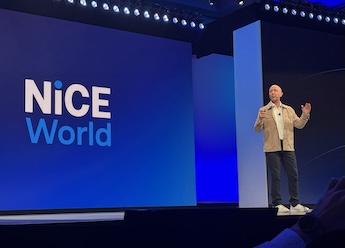
 As NiCE World 2026 wrapped at Walt Disney World Resort last week, it became increasingly clear the company isn’t just bolting AI agents onto CXone, it’s trying to build something underneath the whole portfolio, a kind of operating layer for agentic CX. As CEO Scott Russell said in his opening keynote, it’s all about orchestrating intelligence.
Imagine a system that watches customer interactions, spots friction, notices where automation could help, and then actually builds the fix. It can generate a new AI agent or tweak a workflow, test it, keep it governed, and hand the tricky cases back to a human when judgment or sign-off is needed. That’s the ambition, and it’s a lot bigger than a feature list.
Agentic Analytics and Proactive Service
For years, analytics in this space has mostly explained what already happened. NiCE is changing that. Now analytics runs quietly in the background looking for anomalies like friction points or sentiment dips that keep coming up. Instead of waiting for someone to dig through a dashboard, it surfaces recommendations on its own.
Here’s where it gets interesting. Some of those recommendations can turn into automation. The system can reason through what an AI agent would need to handle a given intent and then spin up that agent so you can test and refine it. This automatic AI agent creation includes linking it to the knowledge, tools and workflow logic required for it to complete the full task. Analytics stops being a rearview mirror and starts becoming a discovery engine. It also provides the tools to move customer service from being reactive to proactive, addressing issues before the customer ever needs to reach out or help.
Cognigy isn’t sitting off to the side as a recently acquired product. Cognigy AI is built right into Agentic Analytics, which shows NiCE is threading it through the intelligence, agent-building, and orchestration parts of the portfolio. If that’s accurate, NiCE Cognigy is central to the shift from analytics and routing toward continuously finding and running automations that uplift CX.
NiCE’s Wider Cast of Characters for Orchestrating Intelligence
There’s more to the architecture than analytics: Agentic Experience Optimization, Guardian AI, Experience Memory, the Agentic Experience Plane, and an AI-first desktop all show up. A few are worth calling out:
- Guardian AI is the oversight layer for AI agents. It keeps an eye on things like brand alignment, agents drifting off script, containment slipping, and sentiment dropping, then suggests fixes a human can approve or wave off.
- Experience Memory builds a live record of each customer’s journey by plugging into enterprise systems and tracking the events that actually matter to that customer.
- The Agentic Experience Plane is pitched as open and vendor-neutral, with room for third-party agents, dialers, and services through MCP (Model Context Protocol). Realistically, CXone customers will probably get the deepest native value, but the openness is the headline NiCE wants you to hear.
On the AI-first desktop, people aren’t just working a queue of interactions. They’re collaborating directly with AI agents, watching for where the agents need a hand, approving recommendations, stepping in when it counts, and leaning on journey context from Experience Memory to make sharper calls.
Broader Implications: The Hybrid Workforce Is Becoming the Operating Model
AI agents are moving from the edge of the contact center into the workforce model itself. They’re still technology, of course. But NiCE, its customers, and partners increasingly described them as participants in the work, not just software sitting behind the scenes.
 That framing requires a new way to think about AI agents. If they’re truly becoming part of the workforce, the next CX stack can’t treat them as isolated bots, copilots, or workflow add-ons. It needs a shared operating layer for all work performed on behalf of the customer, whether that work is done by a human agent, an AI assistant, an autonomous agent, or eventually a customer’s own AI agent. Essentially, autonomy doesn’t reduce the need for management. It changes what has to be managed.
That starts with a common view of work. The stack needs to know who or what is handling each step, what authority they have, what context they’re using, what policy applies, and when a handoff is required. A copilot suggesting a refund, an autonomous agent approving a change, and a human agent handling an exception should all operate against the same customer state, knowledge sources, permissions, and audit trail.
It also means supervision has to expand. Managers will still coach people, but they’ll also need to monitor AI behavior, evaluate outcomes, test new agent actions, approve policy exceptions, and see where automation is creating friction or risk. The stack will have to make AI performance visible in the same operational frame as human performance.
To read Opus Research’s full analysis from NiCE World 2026 – please click here.
Opus Research’s Amy Stapleton, Ian Jacobs, and Derek Top contributed to this article.
Categories: Conversational Intelligence, Intelligent Assistants, Articles
 Opus Research Report: Agentic Commerce, A 15-Year View of a 2-Year-Old Category
  NiCE Delivered on Cognigy. Now Comes the Hard Part.
  The New Economics of Agentic Voice AI: The True Cost Per Resolution
  Five9’s “Humantic” Bet Is Really a Bet on Conversations