
 Discussions about AI in the contact center often focus on which tasks AI can automate, replacing human work. But as AI capabilities continue to evolve, the new question has become: how do we design workplaces where humans and AI collaborate as effective teammates?
Anthropic’s recently announced Claude Tag feature offers an interesting glimpse into what that future might look like. Currently being tested internally and with select enterprise customers, Claude Tag allows team members to bring Claude into a Slack conversation simply by mentioning it with an @ tag.
Because Claude has access to the conversation history and understands the context of the team’s work, it behaves less like a chatbot answering isolated questions and more like another skilled member of the team. It can write code, summarize discussions, research a topic, or complete other assignments while everyone else continues working.
The idea is surprisingly simple, yet it represents a subtle shift in how we think about AI. Rather than interacting with AI through a separate application or asking it disconnected questions, AI becomes part of the team’s ongoing workflow.
Contact Centers Already Have the Building Blocks
The contact center industry may be closer to this model than many people realize.
Modern CX platforms already collect enormous amounts of operational intelligence. Conversation Intelligence systems analyze millions of customer interactions to identify emerging issues, recommend coaching opportunities, surface compliance risks, and uncover automation candidates. AI copilots assist agents during live interactions. Supervisors monitor dashboards that compare the performance of both human and AI agents. Automation platforms recommend new workflows and even generate AI agents from successful interaction patterns.
These capabilities are becoming remarkably sophisticated. The challenge is that they often remain fragmented across separate applications, dashboards, and administrative consoles.
From Isolated Insights to Shared Context
Today, the human agent works in one interface, while supervisors work in another. Analysts spend their time in Conversation Intelligence dashboards. Automation designers work somewhere else. Valuable insights exist throughout the organization, but they are often disconnected from the people making decisions in real time.
Imagine a different approach. Instead of AI living inside a collection of specialized tools, imagine it becoming an active participant in the operational workspace itself.
An AI teammate could already understand that a new product issue is generating longer call times and that a billing problem is driving higher transfer rates. When an agent encounters a difficult customer interaction, the AI would not simply respond to the current conversation. Instead it would respond with awareness of everything happening across the operation.
The Hybrid Workforce Is Already Taking Shape
Several vendors are already moving in this direction.
At their recent NiCE World conference, for example, the company demonstrated how integrating Cognigy capabilities with the existing Agent Copilot allows AI to perform much of the reasoning behind a customer interaction before presenting a proposed response for the human agent to review, modify, or approve. The human increasingly becomes a supervisor of AI-generated work rather than the sole creator of every response.
Claude Tag suggests extending that same philosophy beyond individual customer interactions and into the broader workplace. As organizations build hybrid workforces composed of both people and AI agents, success may depend less on creating increasingly capable AI and more on designing effective patterns of collaboration between them.
The most successful organizations will determine which work humans perform best, which work AI performs best, and how information flows naturally between them.
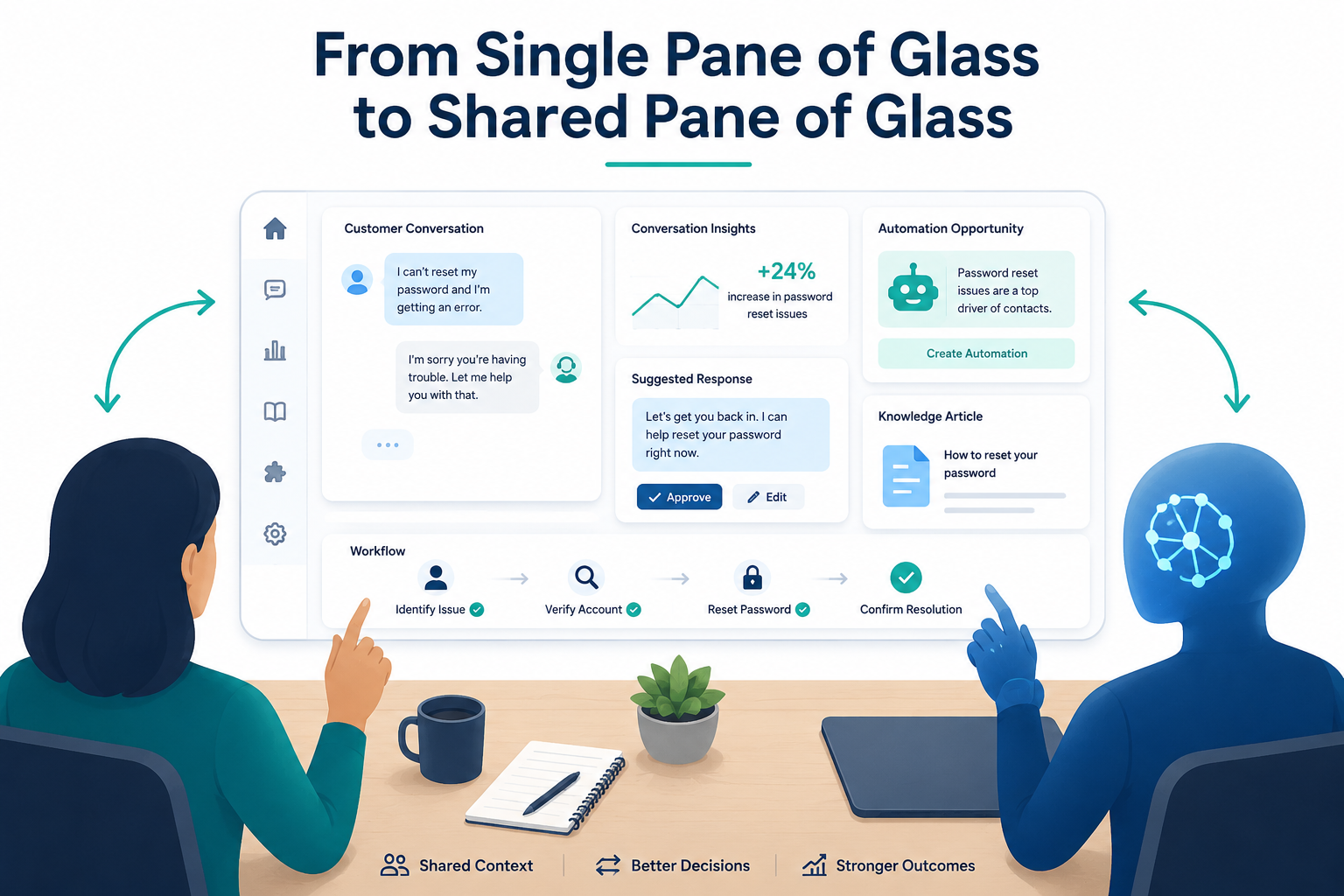
Beyond the Single Pane of Glass
For years, vendors have promised a “single pane of glass” for agents. Perhaps the next evolution is something more ambitious.
A shared pane of glass.
Not one designed exclusively for people and not one designed just for AI. But rather a workspace where humans and AI operate with shared context, contribute different strengths, and continuously make each other more effective.
If Claude Tag represents even an early glimpse of that future, it may offer an important clue about how the next generation of hybrid contact center workforces will operate.
Categories: Articles
 When Your Customer Sends an Agent
  Opus Research Report: Agentic Commerce, A 15-Year View of a 2-Year-Old Category
  NiCE Delivered on Cognigy. Now Comes the Hard Part.
  The New Economics of Agentic Voice AI: The True Cost Per Resolution