
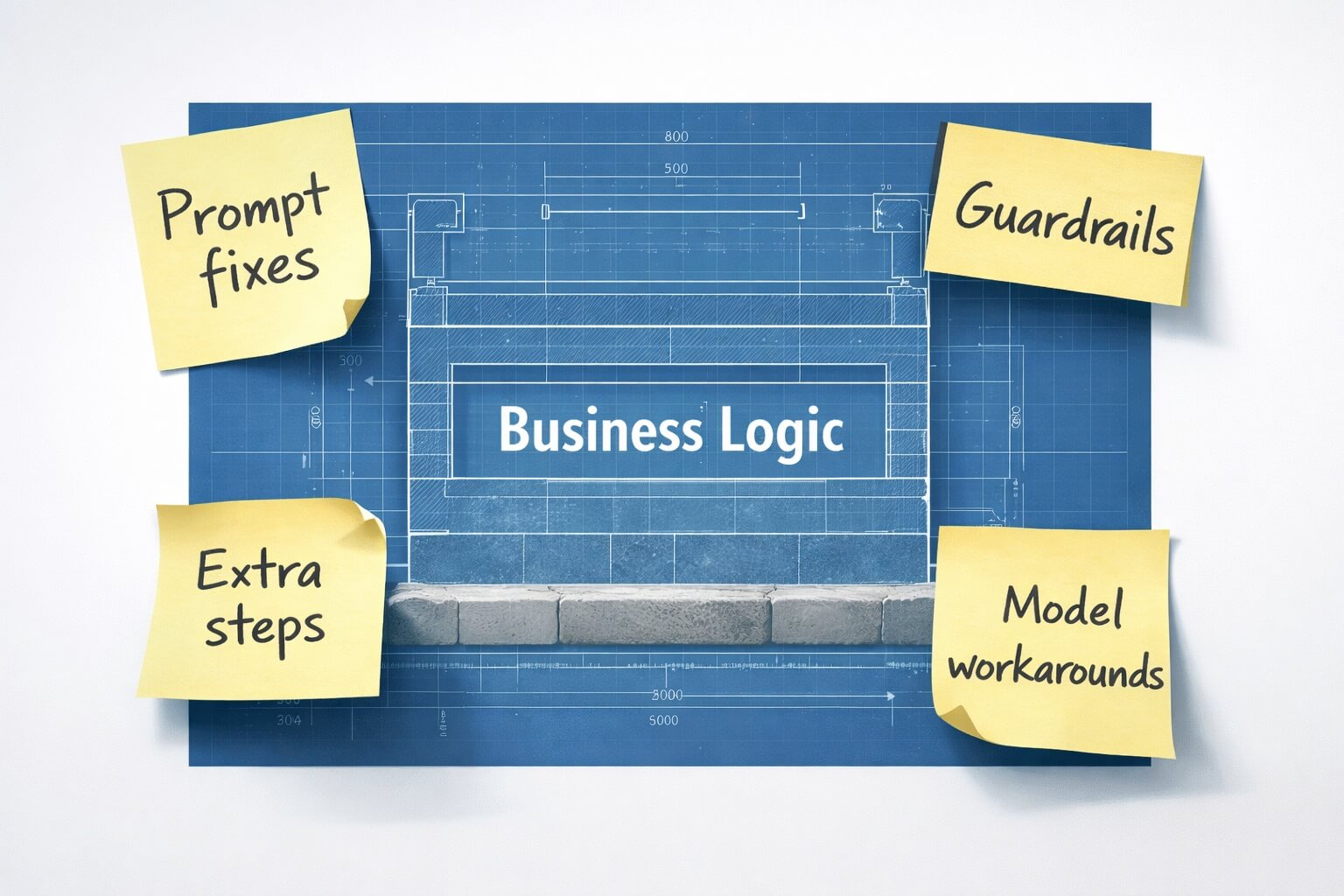
 One of the more interesting problems emerging in CX automation is that some of what vendors call agent design is, in practice, a workaround for the limitations of current models.
As CX platforms roll out Agent Builder tools, they give enterprises a way to define how an AI agent should carry out what a customer wants and needs. That usually means wrapping the model in a harness that helps keep it on course. The harness may shape the prompt structure, control tool use, and add extra steps that make the model easier to steer.
The problem is that not every part of this harness reflects durable business logic. Some of it reflects the limitations of the model at a particular moment. Earlier models needed more help following instructions, reasoning through steps, and deciding when to use tools. So builders compensated within the harness. They broke tasks into smaller pieces, added more structure, and inserted intermediate controls that made the agent more reliable.
But models improve, and they’re improving quickly. As they do, some of the structures built to address yesterday’s limitations stop adding value. Sometimes they become unnecessary. Sometimes they even get in the way, making flows harder to maintain and adapt.
Claude Managed Agents – Recognizing that Harnesses Go Stale
That’s what makes Anthropic’s Claude Managed Agents announcement interesting. Anthropic states the problem directly. Harnesses encode assumptions that can go stale as models improve. The company gives a concrete example of a context-reset technique that helped one Claude model but became dead weight with a stronger successor.
That matters beyond developer tooling because it highlights a broader question for CX vendors and enterprise buyers alike.
Which parts of an agent system are temporary orchestration logic, and which parts reflect the durable operating logic of the business?
That question maps neatly to the control plane idea we’ve been developing at Opus Research. Enterprises shouldn’t confuse a vendor’s current orchestration canvas with their own long-lived operating model.
CX Automation Agent Builder Tools – Model Harness vs. Business Logic
Much of the current CX Automation market is built around visual flows and node-based orchestration layers. A designer specifies the order of operations. But only some of those steps are durable as model capabilities advance.
A year ago, for example, a service bot might have needed a separate intent classification node, then a second node to extract product and issue details, then a third to decide whether to search the knowledge base. That structure made sense when models were weaker at following instructions and deciding what information to gather. But as models improve, one well-scoped service-resolution agent may be able to handle that whole sequence in a single step.
Some nodes are clearly more durable. Requiring authentication before a refund isn’t a workaround for weak reasoning, but rather reflects standard business policy. Checking eligibility before taking action isn’t temporary prompt scaffolding. It’s business logic.
Determining What Is Durable
The architecture employed for Claude Managed Agents reinforces the control plane thesis. Anthropic is effectively saying that the runtime should be designed on the assumption that orchestration will keep changing, but persistent business rules probably won’t.
Yet Anthropic’s design also raises a related question about control. As noted in a recent VentureBeat piece, as managed-agent platforms take on more of the runtime, enterprises need to be deliberate about where durable business logic, policy, action definitions, and event history actually live. The more the runtime becomes managed, the more important it is to keep the enduring operating layer explicit and enterprise-controlled.
When evaluating agent builders and automation platforms, the important question isn’t just whether they can orchestrate AI-driven workflows today. It’s which parts of those workflows represent durable enterprise assets and which parts are just temporary scaffolding around today’s models. Look for implementations that make the durable layer explicit, portable, and governed outside the prompt choreography.
Categories: Articles
 Agentic Commerce Is Starting to Leave a Trail
  Five9’s “Humantic” Bet Is Really a Bet on Conversations
  Who Does Your Personal Agent Work For?
  Salesforce’s Fin Acquisition Expands Its CX Ambitions Beyond Agentforce