
 Intercom’s recent Fin Apex announcement is worth a closer look because it may point to the next phase of competition in AI customer service.
Intercom says Apex is a new AI model for Fin, its AI-powered customer service agent. It was trained by Intercom’s internal AI Group on years of support interactions and now serves as the core answering model for most of Fin’s English-language chat and email conversations. The company also says Apex improved resolution rates for one large customer from 68% to 75%, while also being faster, producing fewer hallucinations, and costing less than the alternative models Intercom had been using.
That mix of stronger performance and better economics is what makes the announcement notable.
The bigger message behind the announcement
Intercom isn’t just talking about a custom AI model. The company is also making a broader argument about where differentiation in AI customer service may be heading.
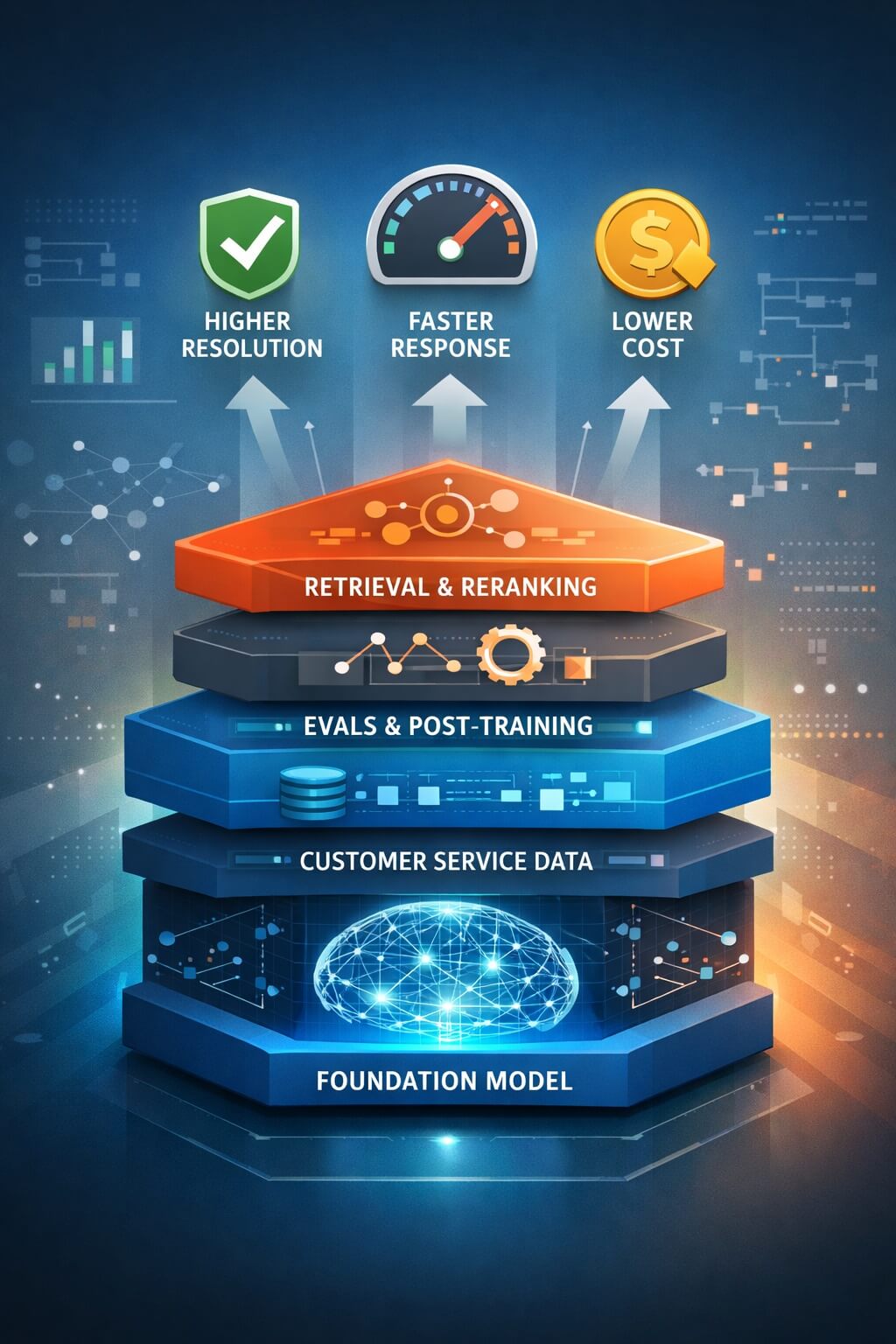
Its position is that vendors won’t get durable differentiation simply by using general-purpose hyperscaler models out of the box. Instead, the advantage may come from combining proprietary customer service data, domain-specific evals, and post-training into a flywheel that improves models for a specific job over time.
For the last couple of years, many vendors have remained credible by taking strong foundation models and building orchestration, workflows, retrieval, and user-facing features around them. That approach still matters. Even so, if Intercom is right, the center of gravity may be shifting toward domain-specific refinement.
Why the cost claim matters
The cost angle is especially important.
If Intercom were only claiming better resolution, that would still matter. But by also claiming that Apex is faster and cheaper, it’s making a much stronger strategic point. In customer service, success isn’t just about whether an AI agent can answer correctly, but also about whether it can resolve issues at scale while remaining cheap enough to make broad deployment economically attractive.
That changes the basis of competition. A vendor that can resolve more issues with lower latency and lower model cost has something tangible to show. Customers care because it affects both service quality and the economics of scaling automation.
What this may mean for CCaaS and conversational AI vendors
If this framing holds up, it raises the bar for the rest of the market. It doesn’t mean every CCaaS vendor has to become a frontier model lab. Still, it probably does mean serious AI CX vendors will need more internal AI capability than some have had in the past.
At a minimum, they’ll need teams that can define and run meaningful evals, measure customer service outcomes, optimize retrieval and reranking, tune routing and tool use, and make informed tradeoffs among accuracy, latency, and cost.
That requires a different competency than simply integrating an API.
This doesn’t automatically mean vertical models win
There is still an important caution here. The claim that vertical models will consistently outperform the best general-purpose models in their own domains has been made before, and it hasn’t always held up. In many cases, what looked like a durable vertical advantage turned out to be a temporary edge built on top of a base model that was later surpassed.
The strongest reading of Intercom’s announcement probably isn’t that pure vertical models are guaranteed to dominate. A better reading is that vertical optimization systems may become increasingly important.
In customer service, the durable edge may come from a continuously improving stack that combines a strong backbone model with proprietary data, evals, retrieval, reranking, workflow integration, and guardrails.
The larger takeaway
Access to powerful general-purpose models is already table stakes. Going forward, the real question may be which vendors have the internal AI teams and expertise to turn that raw capability into better customer service outcomes at the right speed and cost.
Categories: Articles
 Agentic Commerce Is Starting to Leave a Trail
  Five9’s “Humantic” Bet Is Really a Bet on Conversations
  Who Does Your Personal Agent Work For?
  Salesforce’s Fin Acquisition Expands Its CX Ambitions Beyond Agentforce