
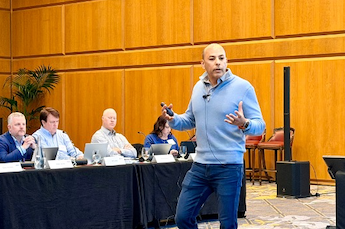
 Five9’s analyst summit last week in Seattle was the first full showing for a largely new leadership team. CEO Amit Mathradas took over in February. He has since brought in CTO Niranjan Vijayaragavan and CSO Rob Hornish, and Jay Lee, the new chief marketing and growth officer, is leading a repositioning that includes new branding and messaging. Rebuilt leadership teams usually spend their first year finding the strategy. This one showed up with a clear thesis and the focus to back it up. The company has new energy, and it appears to be heading in the right direction.
Part of the messaging the team inherited is “Humantic CX,” which Five9 describes as AI working as a constant partner to human work rather than a replacement for it. As a slogan, it sounds like reassurance for buyers nervous about automation. But it also makes a sharper point: as enterprises deploy AI agents, their most valuable asset is the record of their conversations.
The usual case for keeping humans in the loop is about empathy, escalation, and edge cases. Like some other CX vendors, Five9 sees every interaction a human handles as an opportunity to improve AI agents. It draws on assets such as transcripts, resolution paths, quality scores, and judgment calls that never made it into a knowledge base. The result is a compounding loop: human data feeds AI at scale, AI improves self-service and proactive outreach, and every interaction adds to customer memory.
Analytics, QM, and journey insights have long been treated as a reporting layer. In CX orchestration, they become foundational. You can’t design an agent without interaction data, and an understanding of how your best human agents resolve the same problems. And you can’t expand automation safely without evidence of where it is failing. A knowledge and governance layer then organizes the articles, scripts, FAQs, and guidance that AI agents and customer service teams rely on.
Customer Intelligence Makes It Explicit
Five9’s Customer Intelligence pillar, built partly on the Acqueon acquisition, turns voice, chat, email, and third-party data into a customer knowledge graph. Customers underscored the benefits. Advia Credit Union chose to keep its quality data in Five9 for simpler reporting, and it now measures success by agent and member satisfaction rather than savings. TruConnect had agent assist in place before it put voice AI in front of 100% of its calls. The intelligence came first, and the automation followed.
With CRM and CCaaS vendors converging on ownership of the end-to-end customer journey, it’s no surprise that customer data and knowledge graphs are getting so much emphasis. Conversation records reveal signals that account records never can. Five9 is committed to keeping the data portable and under enterprise control.
The leadership team was also candid that a lot remains unknown. Asked about the biggest threat, Mathradas named “the unknown,” including whether frontier labs will move into the space. Personal AI agents calling on behalf of consumers are coming, and the rules for orchestrating them across vendors are still being written. Nobody has these answers yet. What Five9 can control is the asset that holds its value whichever way those questions break.
The new team wants to own “the interaction layer.” Humantic is the right name for that only if the humans are what make the layer intelligent. AI agents are becoming commodities fast. The conversations used to train, ground, and evaluate them are not, and that is what Five9 is betting on.
Open by Design
Five9’s bet on the interaction layer also depends on another part of its strategy. It doesn’t expect enterprises to standardize on one vendor for CRM, AI, data, and customer service. In fact, Amit Mathradas argued that the opposite is more likely. “I actually think that in the new world, open ecosystems are the ones that are going to win, and I think it’s going to be required.”
Repeatedly saying “open” these days could just mean that a vendor is banking up connectors to leading third-party software, but here it seems to be a bit more than just an integration story. Five9 is positioning itself as a neutral layer that can sit across CRM systems, hyperscalers, AI models, customer-built applications, and third-party AI agents. Mathradas was clear that the company would obviously prefer customers to buy (and use) more of the Five9 portfolio, but its strategy doesn’t depend on owning every component in the stack. Customers could use another vendor’s AI agent, for example, while Five9 continues to provide the interaction and orchestration layer.
Really, Mathradas was unusually direct about the role Five9 wants to play. “I actually think that a neutral third party that sits on top of all of it and says, ‘I do the interaction layer and I do it damn well and I integrate with all the other systems directly that you use for data’ is where this world is going.”
That position becomes more interesting as AI increases the number of systems involved in a customer interaction. A service journey might touch CRM, an AI agent, a payment system, a knowledgebase, some sort of CDP (customer data platform), and eventually a human agent. The more heterogeneous that environment becomes, the harder it is for any one vendor’s walled garden to contain the entire experience.
To be clear, openness alone won’t be much of a differentiator for Five9 or any other vendor. Every major CX vendor has APIs and partnerships. The real test is whether Five9 can preserve context and coordinate decisions, data, and workflows as interactions move across those boundaries.
There’s also a commercial consequence to this strategy. If Five9 can work credibly with competing AI agents and adjacent platforms, it doesn’t have to win every technology decision to stay strategically important. That could make it easier to enter accounts, expand over time, and avoid the all-or-nothing platform sale. In that sense, openness isn’t just an architectural choice. It may also be a smart go-to-market move.
Categories: Conversational Intelligence, Intelligent Assistants, Articles
 Sprinklr Bets That Context, Not Agents, Wins the Next Round of CX
 2026 BPO, AI & CX Intelliview: From Labor Arbitrage to Managed AI Operations
 Dialpad and Ada Combine to Build a Platform for Customer Work
 Opus Research Report: Agentic Commerce, A 15-Year View of a 2-Year-Old Category